- +263 242 307793 | 0785 541 612
- info@fawezi.org
- Kenyan Embassy 95 Parklane, 1st Floor, Northwing, Harare


News Details
- June 25, 2026
- 755 views
- 0
“They Used to Laugh at My Eyes” – How One Girl Found Her Voice Through a Safer School Environment
At just 15 years old, Audrey Apololi has lived through something no child should ever face in school: isolation, bullying, and shame, not because of anything she did but simply because of how she looks.
“I used to dread coming to school. The boys in my class would laugh at me, call me names because of how I look. They said I had big eyes, big ears. Some days, I couldn’t even walk into the classroom without hearing whispers behind my back.” Says Audrey
Audrey is a Form 2 student at Seke Mhuriimwe Secondary School in Zimbabwe. For months, a group of boys in her class would taunt her daily, poking fun at her appearance. What started as a few jokes quickly became a daily routine of verbal bullying that left Audrey feeling isolated and embarrassed. This drained her confidence and disrupted her ability to concentrate in class.
“Sometimes, I would fake being sick just to stay home. I felt like I didn’t belong.”
She witnessed change when her school became part of the Data for Change initiative a project designed to confront and dismantle School-Related Gender-Based Violence (SRGBV), implemented by the Forum for African Women Educationalists Zimbabwe (FAWEZI) in partnership with the Ministry of Primary and Secondary Education, with support from FAWE and Together for Girls.
Audrey’s story is not unique. Across Zimbabwe, and in many parts of the world, learners, especially girls, are subjected to School-Related Gender-Based Violence (SRGBV), a silent epidemic that often goes unchecked. Verbal abuse, bullying, inappropriate comments, and physical harassment have become all too common in school environments where gender power dynamics and lack of awareness create fertile ground for harm. According to the 2021 Zimbabwe violence against children survey report 10% of the 142,749 female respondents aged 13 – 24 years experienced emotional violence.
Before the project’s intervention, Seke Mhuriimwe Secondary School, like many others, lacked formal structures to address bullying and gender-based harassment. Teachers often viewed such behavior as harmless teasing, while affected learners, like Audrey, bore the brunt of the emotional and psychological consequences in silence.
The Data for Change project sought to break this cycle by using data-driven strategies and structured training to raise awareness, build capacity, and institutionalize systems for prevention and response to SRGBV.
Through the project, selected teachers from six schools, including Audrey’s guidance and counselling teacher, were trained using the School-Related Gender-Based Violence Manual. The manual equips educators with practical tools to recognize and respond to different forms of SRGBV and to promote respectful, inclusive environments within their classrooms.
The training emphasized the importance of:
- Positive communication between learners;
- Proactive prevention of bullying and verbal abuse;
- Child-friendly reporting pathways for cases of SRGBV;
“Our teacher came back from the training, and everything changed,” Audrey explains.
“She started talking to us about respect. She told us that the things we say to each other matter, saying, words can build or break someone.”
In a series of Tuseme Club sessions, the teacher engaged students boys and girls, in open discussions about how name-calling and teasing affect their peers. She emphasized that learners needed to treat one another like siblings, building a culture of unity and empathy. Reporting mechanisms were also introduced, allowing students to share concerns without fear of retaliation or blame.
“The boys who used to laugh at me apologized. They told me they didn’t know how much it hurt. Now, they treat me with respect. We talk, we share notes, we help each other with homework.” Says Audrey
With these changes, something shifted in Audrey. She began to lift her head higher, participate more in class, and interact with her classmates, boys included.
“Now they treat me like a sister. The same boys who used to mock me now talk to me with respect.”
For Audrey, the project didn’t just make school bearable again; it made it joyful. Her attendance has improved. Her confidence is growing. Most importantly, she knows she has the right to be herself without fear.
“I feel like I belong now. I’m not afraid anymore,” she says. “I know I have the right to be here, to learn, to be myself.”
Teachers at Seke Mhuriimwe Secondary confirm that overall discipline and mutual respect among learners have improved significantly since the introduction of the Data for Change project. Incidents of bullying have declined, and students now feel more empowered to report issues early.
“Having clear guidance from the SRGBV manual and support from the Ministry of Primary and Secondary Education and FAWEZI made a big difference.
“We did not know how to intervene in these issues. Now we have tools, support systems, and a new mindset,” says Ndaneta Chivaviro, Audrey’s Guidance and Counseling teacher and Tuseme Club Mentor.
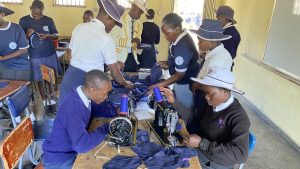
Mrs Ndaneta Chivaviro (center), Tuseme Teacher, Seke Mhuriimwe Secondary, facilitating a training session on
re-usable sanitary pads one of the initiatives Seke Mhuriimwe Secondary Tuseme club is undertaking to combat
SRGBV and Period poverty
While the impact of the Data for Change project at Audrey’s school is undeniable, as with all social change, sustainability remains the biggest challenge. Teachers need continued support. Reporting systems need to be maintained and strengthened. And cultural mindsets around gender and power must be continuously addressed, not just through policy but through consistent practice.
