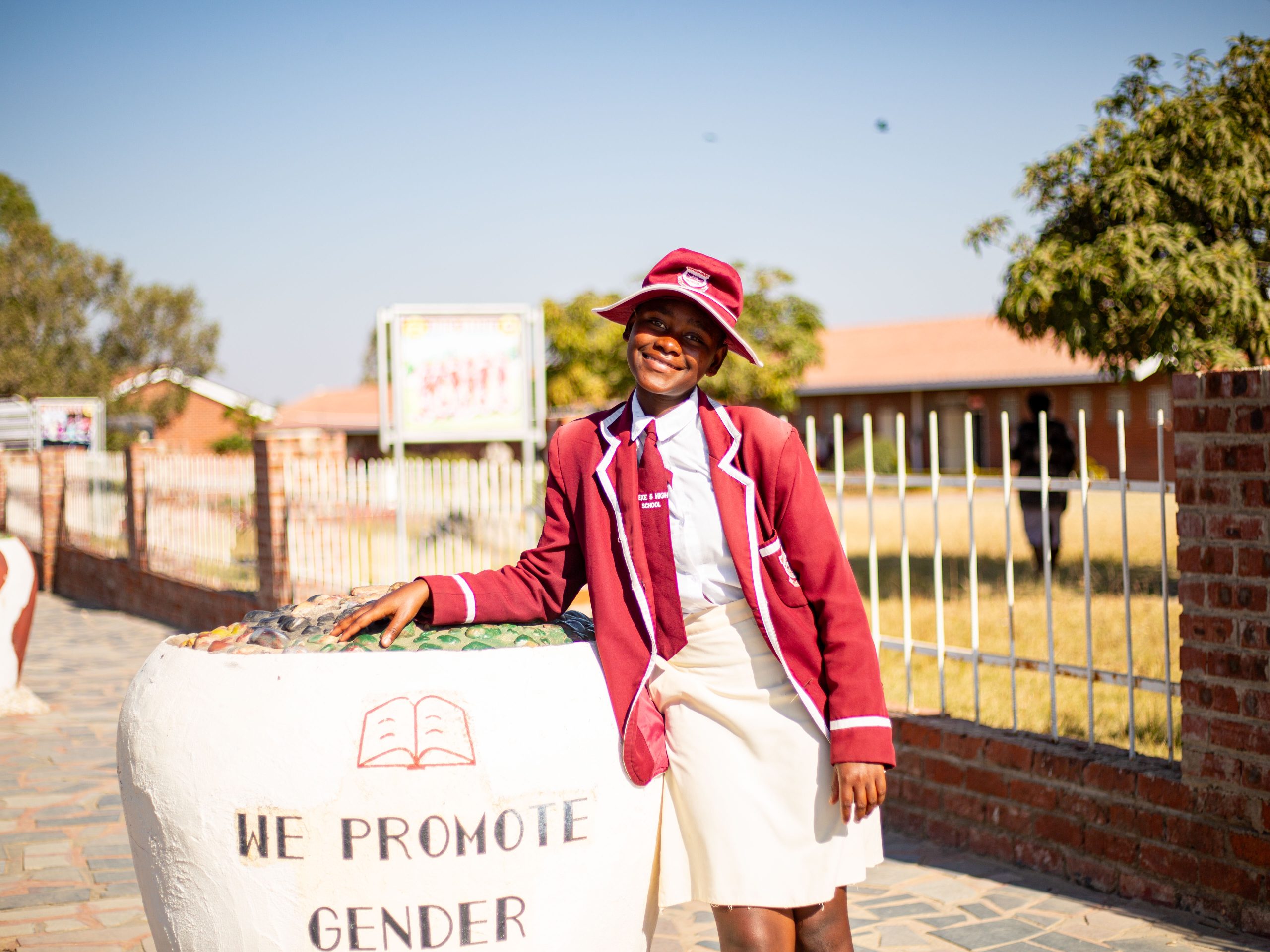
How one learner found her voice and is helping other girls speak Out at Seke 5 High School in Chitungwiza
When 16-year-old Laisy Manyere talks about her dream of becoming a lawyer, she speaks with the confidence of someone who has already discovered the power of advocacy.
“I want to defend people whose rights are violated. I want to stand for justice and make sure everyone’s voice is heard,” says the Form Three learner at Seke 5 High School in Chitungwiza.
Just a few years ago, Laisy says she would never have imagined speaking confidently in front of her peers about sensitive issues such as school-related gender-based violence, child marriage and teenage pregnancy. Today, she is one of more than 70 learners who make up the school’s growing Tuseme Club, where girls and boys use creative arts to raise awareness, challenge harmful social norms and advocate for safer schools.
“I am seeing a big change in our school. Girls are now advocating for their rights,” she says
Laisy’s journey is one of many being shaped through the Resilient, Innovative, Skilled and Empowered (RISE) Project, a project implemented in partnership with the Government of Zimbabwe across 30 schools and 5 wards in Chitungwiza and Chipinge districts, the project is helping adolescent girls stay in school, strengthening child protection systems and creating opportunities for young people to become confident advocates for their own wellbeing and future.
For Laisy, that change began with finding her voice.
Laisy lives in Chitungwiza with her mother and two siblings. She was only two years and eight months old when her father passed away, leaving her mother to raise the family on her own. Watching her mother persevere through difficult circumstances taught her resilience from an early age.
“It has not always been easy. Seeing my mother work hard has motivated me to work hard at school so that I can build a better future,” she says
Her ambition to become a lawyer stems from a passion for standing up for others but joining the Tuseme Club has transformed that ambition into action.
“I have learnt that advocacy starts where you are. You don’t have to wait until you are grown up to help other girls,” she says
Laisy says many girls at Seke 5 High School did not know where to report cases of School-Related Gender-Based Violence or other challenges affecting their education.
“There were no proper reporting systems. Girls were afraid to speak because they did not know who would listen,” she says
One incident continues to stay with her.
She remembers a fellow learner who dropped out of school after becoming pregnant.
“When she left school, we realised how easily a girl’s education could end. At that time, there was nowhere for girls to raise concerns safely.”
That experience highlighted the importance of creating safe spaces where girls could speak openly and be heard.
Through the RISE Project, in-school and out-of-school adolescent girls in Chitungwiza and Chipinge districts received training on the Advocacy Guide and the Tuseme ‘speak out’ model a participatory approach that empowers learners to identify challenges affecting them, analyse their causes and advocate for solutions.
The school established a Tuseme Club, which has since grown to more than 70 active members, reflecting increasing interest among learners who want to become agents of change within their school.
Using theatre, poetry, music and dialogue, club members educate their peers on issues affecting adolescent girls while encouraging positive behaviour change among both girls and boys.
One of their most popular performances is a reimagined version of Oliver Mtukudzi’s Todii, adapted to promote girls’ education while challenging child marriage, teenage pregnancy and school-related gender-based violence.
“When we perform, learners relate to the messages because they recognise the songs. Creative arts make it easier for people to understand difficult issues,” she says
The impact is evident across the school.
A suggestion box now provides learners with a confidential way of reporting concerns and is reviewed every week by Guidance and Counselling teachers. School rules are displayed around the school alongside advocacy posters carrying messages on ending school-related gender-based violence, preventing child marriage and supporting girls’ education.
For Laisy, these visible changes represent something even more important, a shift in school culture.
“Girls are now confident enough to speak when something is wrong. They know there are teachers who will listen and support them,” she says
She has also seen greater openness around menstrual health, helping girls attend school with increased confidence during their menstrual cycles.
For Selina Kureva (52), the teacher-mentor supporting the Tuseme Club, the greatest achievement has been watching girls develop the confidence to lead.
“The RISE Project has helped our girls develop agency. They are identifying, analysing and addressing issues such as teenage pregnancy, child marriage, School-Related Gender-Based Violence and poor Menstrual Health Management.”
Ms Kureva says girls who once hesitated to participate now lead awareness campaigns during school assemblies and perform before parents and community members during events such as prize-giving ceremonies.
“They are no longer waiting for adults to speak on their behalf. They are becoming advocates for themselves and for other learners,” she says
She has also observed encouraging changes among boys.
“As girls become more confident, we are seeing boys becoming more respectful. Learners are beginning to understand that everyone has the right to learn in a safe environment,” she says
She believes these changes will have lasting benefits beyond the school gates.
“When girls understand their rights and recognise that the decisions they make today shape their future, they become better equipped to achieve their goals.”
Across the 30 RISE Project schools in Chitungwiza and Chipinge districts, adolescent girls are gaining more than knowledge. Through integrated support that combines education, child protection, health promotion, life skills development and community engagement, the project is helping girls remain in school while strengthening the systems that protect them from violence and harmful practices.
For Laisy, those investments have transformed her outlook. She no longer sees herself only as a learner. She sees herself as an advocate.
“I want every girl to know that she has rights and that she should never be afraid to speak. When girls find their voices, they can change their own future, and they can help change someone else’s too.”
Menard Ziko