FAWEZI and MHTEISTD Advance Inclusive STEM Pathways Through National Curriculum Development Workshop
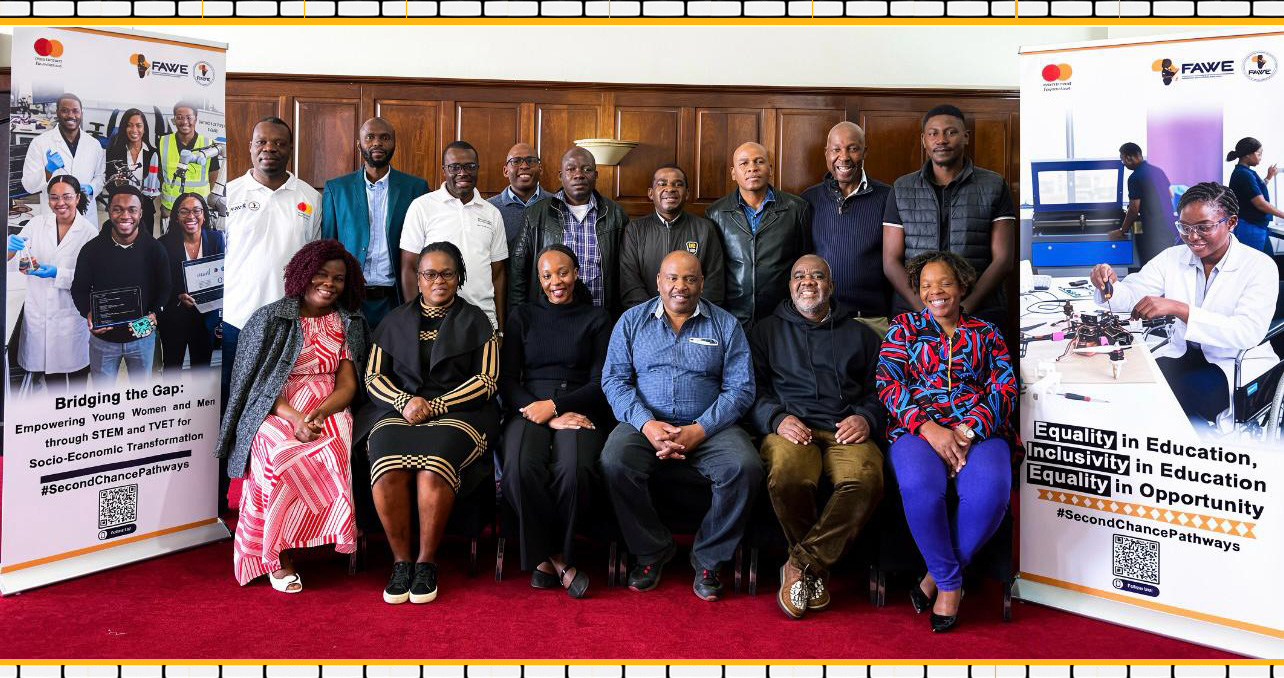
Bulawayo, Zimbabwe — The Forum for African Women Educationalists Zimbabwe (FAWEZI), in partnership with the Ministry of Higher and Tertiary Education, Innovation, Science and Technology Development (MHTEISTD), supported a three-day national curriculum development workshop in Bulawayo to strengthen access to Science, Technology, Engineering and Mathematics (STEM) education through the National Science Foundation Programme (NSFP).
Held under the FAWE/Mastercard Foundation Phase II Programme, the workshop brought together representatives from 13 higher and tertiary education institutions to finalise the National Science Foundation Programme/Higher Education Access Certificate (NSFP/HEAC) curriculum and develop standardised learning materials to support consistent, quality programme delivery across participating institutions.
The workshop marked an important milestone in strengthening a nationally coordinated and inclusive pathway into tertiary STEM education, particularly for young women and men who face barriers to accessing conventional higher education entry routes.
Strengthening Second-Chance Pathways into Tertiary STEM Education Access to higher education remains an important determinant of young people’s opportunities to develop specialised skills, pursue meaningful careers and contribute to national development. However, some young people encounter barriers that limit their ability to transition directly from secondary school into higher and tertiary education, despite having the potential and determination to succeed.
The National Science Foundation Programme provides an opportunity to strengthen alternative access pathways, enabling eligible young people to build the foundational knowledge and competencies required to pursue further studies in STEM-related fields.
Through the FAWE/Mastercard Foundation Phase II Programme, FAWEZI is working with government and higher and tertiary education institutions to expand equitable access to these opportunities, with particular attention to young women and other marginalised groups.
The curriculum development workshop sought to strengthen the foundation of this pathway by ensuring that the programme is supported by a structured curriculum, standardised learning resources and approaches that promote quality and consistency across participating institutions.
13 Institutions Collaborate on a National STEM Access Framework The three-day workshop brought together 41 participants, comprising 29 males and 12 females, representing 13 higher and tertiary education institutions from across Zimbabwe.
Participating institutions were:
Bindura University of Science Education (BUSE)
Chinhoyi University of Technology (CUT)
National University of Science and Technology (NUST)
Midlands State University (MSU)
Catholic University in Zimbabwe
Marondera University of Agricultural Sciences and Technology (MUAST)
Manicaland State University of Applied Sciences (MSUAS)
Zimbabwe Open University (ZOU)
Harare Institute of Technology (HIT)
Great Zimbabwe University (GZU)
University of Zimbabwe (UZ)
Gwanda State University
Lupane State University
The participation of these institutions provided a platform for collaboration among higher and tertiary education stakeholders to develop a common foundation for programme implementation.
By bringing together expertise from across the tertiary education sector, the workshop supported collective efforts to align curriculum content, strengthen teaching and learning resources, and establish a more coordinated approach to preparing learners for further studies in STEM disciplines.
This collaboration is essential to ensuring that young people entering the programme receive a consistent educational foundation, regardless of the participating institution through which they access the pathway.
NSFP/HEAC Curriculum Finalised for Submission to ZIMCHE A key outcome of the workshop was the successful finalisation of the National Science Foundation Programme/Higher Education Access Certificate curriculum, which will be submitted to the Zimbabwe Council for Higher Education (ZIMCHE) for accreditation.
The curriculum is intended to provide a structured foundation for learners seeking to progress into higher education through the NSFP/HEAC pathway.
Its finalisation represents an important step towards establishing a nationally coordinated framework that supports access to tertiary STEM education while promoting consistency in curriculum delivery across participating institutions.
The planned submission to ZIMCHE for accreditation is a further step in the process of securing formal recognition of the curriculum and strengthening the programme’s institutional foundation.
Once the relevant accreditation processes have been completed, the curriculum is expected to provide a basis for participating institutions to deliver the programme within an agreed framework of learning outcomes and academic expectations.
Standardised Learning Materials to Support Quality Delivery In addition to finalising the curriculum, participants developed structured and standardised workbooks and learning modules for four core STEM subjects: Mathematics, Biology, Chemistry and Physics.
These resources are intended to support lecturers in delivering the programme through a more coordinated approach to teaching and learning, while providing learners with structured materials to guide their studies.
Standardised learning resources are particularly important in a multi-institutional programme because they help establish a common academic foundation and promote consistency in the content delivered across different institutions.
The development of these materials also provides an opportunity to strengthen the quality of learning experiences for programme participants as they prepare for further studies in STEM-related fields.
By combining curriculum development with the preparation of practical teaching and learning resources, the workshop addressed two important components of effective programme implementation: what learners need to learn and the materials required to support that learning.
Embedding Gender-Responsive Pedagogy in STEM Education Recognising that access alone is not enough to guarantee equitable educational outcomes, FAWEZI facilitated a session on Gender Responsive Pedagogy (GRP) during the workshop.
The session equipped lecturers with practical approaches to promote inclusive, learner-centred and gender-responsive STEM education.
Gender-responsive pedagogy recognises that learners may experience different barriers to participation and achievement, including gender stereotypes, classroom dynamics and unequal opportunities to engage in learning activities. It encourages educators to identify and address these barriers through their teaching practices and interactions with students.
For STEM education, this is particularly important in creating learning environments where young women are encouraged to participate actively, ask questions, experiment, contribute ideas and develop confidence in their abilities.
The session strengthened participants’ understanding of how teaching approaches can influence learners’ access, participation and success. It also reinforced the importance of ensuring that the expansion of STEM education is accompanied by deliberate efforts to make learning environments more equitable and supportive for all students.
Through this intervention, FAWEZI highlighted the importance of integrating gender responsiveness into curriculum implementation and classroom practice rather than treating inclusion as a separate consideration.
Advancing Equitable Access to Higher Education Through Partnership The workshop demonstrated the importance of collaboration between government, higher and tertiary education institutions and development partners in strengthening alternative pathways into higher education.
MHTEISTD’s partnership with FAWEZI provides an important platform for aligning programme implementation with national higher education priorities, while the involvement of the 13 institutions contributes the expertise and institutional collaboration required to advance the NSFP/HEAC pathway.
Through the FAWE/Mastercard Foundation Phase II Programme, FAWEZI continues to support efforts to expand access to tertiary education for marginalised young women and men, helping create opportunities for those who might otherwise face barriers to pursuing further studies.
The programme’s focus on access pathways, supported by curriculum development, standardised learning materials and gender-responsive teaching approaches, reflects a holistic approach to widening participation in STEM education.
Such efforts are important in building a more inclusive higher education system in which opportunities to develop scientific knowledge, technical skills and professional competencies are accessible to a wider range of young people.
Creating Opportunities for Young Women and Men to Shape Zimbabwe’s Future Expanding access to STEM education is central to developing the skills and expertise needed to support innovation, technological advancement and national development.
For young women and men who have faced barriers to conventional entry routes, alternative pathways such as the NSFP/HEAC can provide opportunities to demonstrate their potential and progress towards further education.
The outcomes of the Bulawayo workshop represent progress towards establishing a more structured and coordinated foundation for these opportunities. The finalised curriculum, the development of standardised learning resources and the emphasis on gender-responsive pedagogy are important components of efforts to strengthen both access and the quality of learning.
As the curriculum proceeds towards submission to ZIMCHE for accreditation, continued collaboration among the Ministry, participating institutions and programme partners will be important in advancing implementation.
Through its partnership with MHTEISTD and the support of the Mastercard Foundation, FAWEZI remains committed to championing equitable, quality education and creating second-chance pathways that enable more young women and men to access tertiary education, develop their potential and contribute meaningfully to Zimbabwe’s development.
Menard Ziko